Review and Herald, March 17, 1977
pp 17, 18


p 15

 |
Far Eastern Division Outlook, VOL. 16 SHANGHAI, CHINA, NOVEMBER, I927 NO. 11
p 8


http://docs.adventistarchives.org/docs/RH/RH19300529-V107-22__B.pdf#view=fit
The Advent Review and Sabbath Herald, Vol. 107 Takoma Park, Washington, D. C., May 29, 1930 No. 22
p 26


The Advent Review and Sabbath Herald, Vol. 108 Takoma Park, Washington, D. C., November 12, 1931 No. 46
p 10

Far Eastern Division Outlook, Vol. 21 December, 1932 No. 12
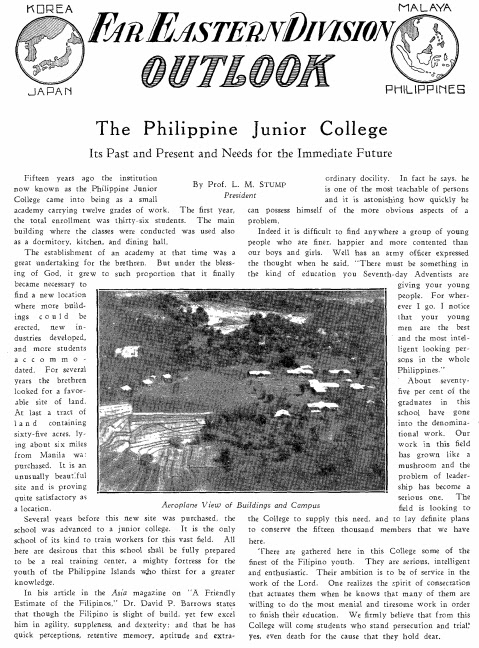
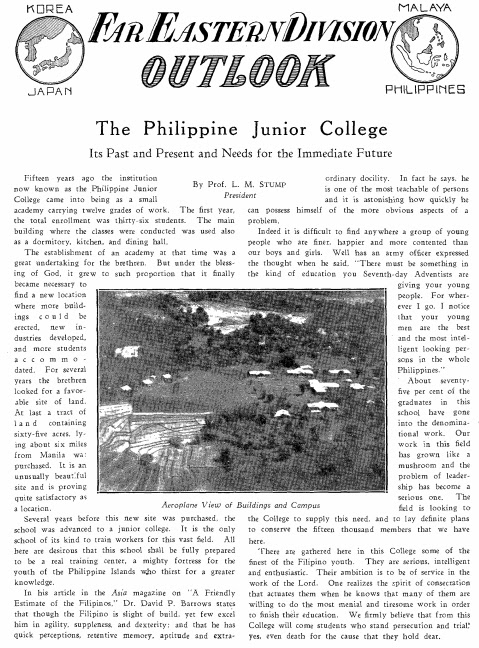
pp 3, 4

Republic of the Philippines
SUPREME COURT
Manila
FIRST DIVISION
G.R.
No. 124554 December 9, 1997
ETERNAL GARDENS MEMORIAL PARK CORPORATION, petitioner, vs. COURT OF APPEALS and NORTH PHILIPPINE UNION MISSION OF THE SEVENTH DAY ADVENTIST, respondents.
KAPUNAN, J.:
This case if the derivative of G.R. No. 73794, which was decided by the Second Division of this Court on September 19, 1988. 1
The antecedents are as
The antecedents are as
follows: 2
Petitioner EGMPC and private respondent NPUM entered into a Land Development Agreement dated October 6, 1976. Under the agreement, EGMPC was to develop a parcel of land owned by NPUM into a memorial park subdivided into lots. The parties further agreed —
(d) THAT the FIRST PARTY shall receive forty (40%) percent of the gross collection less Perpetual Care Fees (which in no case shall exceed 10% of the price per lot unless otherwise agreed upon by both parties in writing) or Net Gross Collection (NGC) from this project. This shall be remitted monthly by the SECOND PARTY in the following manner: (i) Forty (40%) percent of the NGC, plus (ii) if it becomes necessary for the FIRST PARTY to vacate the property earlier than two years from the date of this agreement, at the option of the FIRST PARTY, an additional amount equivalent to twenty (20%) percent of the NGC as cash advance for the first four (4) years with interest at twelve (12%) percent per annum which cash advance shall be deductible out of the proceeds from the FIRST PARTY's 40% from the 5th year onward. The SECOND PARTY further agrees that if the FIRST PARTY shall desire to have its projected receivables collected at the 5th year, the SECOND PARTY shall assist in having the same discounted in advance. The P1.5 million initial payment mentioned in the Deed of Absolute Sale, covering the first phase of the project, shall be deducted out of the proceeds from the FIRST PARTY's 40% at the end of the 5th year. Subsequent payments made by the SECOND PARTY on account of the stated purchase price in said Deed of Absolute Sale shall be charged against what is due to the FIRST PARTY under this LAND DEVELOPMENT AGREEMENT. 3
Later, two claimants of the parcel of land surfaced — Maysilo Estate and the heirs of a certain Vicente Singson Encarnacion. EGMPC thus filed an action for interpleader against Maysilo Estate and NPUM, docketed as Civil Case No. 9556 before the Regional Trial Court of Kalookan City, Branch 120. The Singson heirs in turn filed an action for quieting of title against EGMPC and NPUM, docketed as Civil Case No. C-11836 before Branch 122 of the same court. From these two cases, several proceedings ensued. One such case, from the interpleader action, culminated in the filing and subsequent resolution of G.R. No. 73794. In G.R. No 73794, EGMPC assailed the appellate court's resolution requiring "petitioner Eternal Gardens [to] deposit whatever amounts are due from it under the Land Development Agreement with a reputable bank to be designated by the respondent court." 4
In the Decision of September 19, 1988, the court ruled thus:
PREMISES CONSIDERED, (a) the petition is DISMISSED for lack of merit: (b) this case (together with all the claims of the intervenors on the merits) is REMANDED to the lower court for further proceedings; and (c) the Resolution of the Third Division of this Court of July 8, 1987 requiring the deposit by the petitioner (see footnote 6) 5 of the amounts contested in a depository bank STANDS (the Motion for Reconsideration thereof being hereby DENIED for reasons already discussed) until after the decision on the merits shall have become final and executory. Entry of judgment was made on April 24, 1989. 6
Sometime thereafter, the trial court rendered decisions in Civil Case Nos. 9556 (interpleader) and C-11836 (quieting of title). These decisions were appealed to the Court of Appeals, and the appeals were consolidated. The appellate court rendered judgment in the consolidated case on December 17, 1991 as follows: (a) the trial court's decision in Civil Case No. 9556 was affirmed insofar as it dismissed the claims of the intervenors, including the Maysilo Estate, and the titles of NPUM to the subject parcel of land were declared valid; and (b) the trial court's decision in Civil Case No. C-11836 in favor of the Singson heirs was reversed and set aside. 7
From the consolidated decision, the Singson heirs, Maysilo Estate and EGMPC each filed with this Court their petitions for review on certiorari. The petition filed by the Singson heirs docketed as G.R. No. 103247-48 was denied for failure to comply with Circular No. 28-91, 8 and entry of judgment made on July 27, 1992 G.R. No. 105159 filed by the Maysilo Estate was denied for failure of petitioner to raise substantial legal issues, 9 and entry of judgment made on August 19, 1992. G.R. Nos. 103230-31 filed by EGMPC was denied for failure to comply with Circular No. 19-91, 10 and entry of judgment made on July 20, 1993. EGMPC's other petition, this time under Rule 65, docketed as G.R. Nos. 107646-47 was dismissed for having been filed out of time and for lack of merit. Following these, the Court, through the Third Division, issued a Resolution dated December 1, 1993 in G.R. No. 73794, thus:
WHEREFORE, considering that the ownership of the property in dispute has now been settled with finality, the Court sees no further legal obstacle in carrying out the respective covenants of the parties to the Land Development Agreement. . . In respect to the mutual accounting required to determine the remaining accrued rights and liabilities of said parties, the case is hereby remanded to the Court of Appeals for proper determination and disposition. All other incidental motions involving G.R. No. 73794, still pending with this Court, are hereby, declared MOOT and are NOTED WITHOUT ACTION. 11
In compliance with the Supreme Court resolution, the Court of Appeals proceeded with the disposition of the case, docketed therein as CA G.R. SP No. 04869, and required the parties to appear at a scheduled hearing on June 16, 1994, "with counsel and accountants, as well as books of accounts and related records,' to determine the remaining accrued rights and liabilities of said parties." 12
Citing the following provision of the land development agreement:
(e) THAT the SECOND PARTY shall keep proper books and accounting records of all transactions affecting the sale of said memorial lots, which records shall be open for inspection by the FIRST PARTY at any time during usual office hours. The SECOND PARTY shall also render to the FIRST PARTY a monthly accounting report of all sales and cash collections effected the preceding month. It is also understood that all financial statements shall be subject to annual audit by a reputable external accounting firm which should be acceptable to the FIRST PARTY. 13
the appellate court required EGMPC to produce at the scheduled hearings the following documents:
(a) statements of monthly gross income from the year 1981, supported by copies of the contracts/agreements of the sale of lots to buyers/customers; and
(b) summary statements, by month, of the forty per cent (40%) share in the "net gross" income under the land development agreement between the parties. 14
The accounting of the parties' respective obligations was referred to the Court's Accountant, Mrs. Carmencita Angelo, with the concurrence of the parties, to whom the documents were to be submitted. 15
NPUM prepared and submitted a Summary of Sales and Total Amounts Due based on the following documents it likewise submitted to the court. 16
A-1 Land Development Agreement executed between NPUM and EGMPC on October 6, 1976.
A-2 Submittal of requirements filed by EGMPC to the Securities and Exchange Commission dated July 26, 1976 re: its application to develop, sell and maintain a first class private cemetery part situated in Baesa, Kalookan City on the 23 has. property of PUC of NPUM. EGMPC's application calls for the development of 31,326 lawn type memorial lots for underground and above ground interment, and 20,808 garden and family/estates memorial lots for above ground interment, or a total of 52,134 memorial lots.
A-3 EGMPC Daily Sales Report which shows that from 1978, 1979, 1980 and 1981 EGMPC has sold 19,237 memorial lots with gross sales amounting to P52,421,879.70.
A-3a Machine copy of EGMPC Daily Sales Report dated December 29, 1979 showing that in 1978 it sold 2,805 memorial lots valued at P5591,716.40 and in 1979 it sold 5,503 memorial lots valued at P11,943,631.00.
A-3a-1 Weekly Sales Report of EGMPC corresponding to the period December 26 to 31, 1979, showing cumulatively as of said date it has sold a total of 5,503 memorial lots from January 1 to December 29, 1979.
A-3a-2 Sales Report of EGMPC for the period February 12 to 18, 1980.
A-3a-4 Letter of Gabriel O. Vida, Executive Vice President and General Manager of EGMPC, dated April 9, 1980, to Pastor Bienvenido Capuli stating among others that for the year 1978, EGMPC has sold 2,805 memorial lots and in the first quarter of 1980 from January 1 to April 2, it has sold 2,418 memorial lots, for a total gross sales of 10,730 memorial lots.
A-3b EGMPC Daily Sales Report which show that from 1978 up to December 9, 1980 it has sold a total of 15,253 memorial lots with sales value of P38,085,299.40.
A-3b-1 Are supporting sales records and/or weekly sales report of EGMPC
A-3b-2 in relation to Exhibit "A-3b."
A-3b-3
A-3b-4
A-3b-5
A-3b-6
A-3b-7
A-4 Audited Financial Statement of EGMPC for 1985 which it filed with the Securities and Exchange Commission on April 16, 1986 pursuant to the reportorial requirements of the SEC, with accompanying balance sheet and statement of income and expenses, consisting of five (5) pages.
A-5 Actual Gross Profit Rate of EGMPC for the year 1985 which shows that it sold 3,623 memorial lots valued at P25,299,601.20.
A-6 Machine copy of Assumptions to Projected Cash Flow and Income Statements prepared by EGMPC with assumptions that the 52,000 memorial lots would be sold and that 15% of total sales per year are cash sales and 85% are on installment and that installment sales are payable over a period of 60 moths at 12% interest per annum.
A-7 Formula for Computation of Interest Income for Lots Sold on Installment.
A-8 Sales Price Analysis based on Lawn Class Memorial Lots for the period 1978 to 1988, inclusive.
A-8a Price list issued by EGMPC effective December 1, 1977.
A-9 Computation of interest due for the use of NPUM share.
A-9a Letter dated April 11, 1983 of Alfonso P. Roda, President of PUC of NPUM showing summary of gross collections from memorial lots sales starting January 1978 up to June 1982, inclusive, per computation given to PUC by EGMPC.
A-9b Are validating documents consisting of accounting ledgers
A-9c in support of the computations given by EGMPC to PUC
A-9d as mentioned in Dr. Roda's Letter dated April 11, 1983.
A-10 Promissory Note of EGMPC dated April 6, 1976 issued to NPUM for a loan of P720,000 for which EGMPC agreed to pay 12% interest per annum.
B Price List of Memorial Lots of HIMLAYANG PILIPINO, INC.
B-1 effective February 3, 1981.
C Price List of Memorial Lots of HIMLAYANG PILIPINO, INC.
C-1 effective March 15, 1982.
C-2
D- Price List of Memorial Lots of HIMLAYANG PILIPINO, INC.
D-1 effective February 18, 1983.
D-2
E Price List of Memorial Lots of HIMLAYANG PILIPINO, INC.
E-1 effective January 23, 1984.
E-2
F Price List of Memorial Lots of HIMLAYANG PILIPINO, INC.
F-1 effective July 9, 1984.
F-2
G Price List of Memorial Lots of HIMLAYANG PILIPINO, INC.
G-1 effective March 1, 1985.
G-2
H Price List of Memorial Lots of HIMLAYANG PILIPINO, INC. effective July 1, 1987.
I Price List of Memorial Lots of HIMLAYANG PILIPINO, INC. effective January 4, 1989.
J Price List of Memorial Lots of HIMLAYANG PILIPINO, INC. effective August 2, 1989.
K Price List of Memorial Lots of HIMLAYANG PILIPINO, INC.
K-1 effective February 4, 1990.
L Price List of Memorial Lots of HIMLAYANG PILIPINO, INC. effective February 2, 1991.
M Price List of Memorial Lots of HIMLAYANG PILIPINO, INC.
M-1 effective October 2, 1991.
N Price List of Memorial Lots of HIMLAYANG PILIPINO, INC.
N-1 effective February 5, 1992.
O Price List of Memorial Lots of HIMLAYANG PILIPINO, INC. effective October 9, 1992.
P Price List of Memorial Lots of HIMLAYANG PILIPINO, INC. effective January 15, 1993.
Q Price List of Memorial Lots of HIMLAYANG PILIPINO, INC. effective February 16, 1993.
R Price List of Memorial Lots of HIMLAYANG PILIPINO, INC.
R-1 effective March 16, 1993.
S Price List of Memorial Lots of HIMLAYANG PILIPINO, INC.
S-1 effective September 15, 1993.
T Price List of Memorial Lots of MANILA MEMORIAL PARK
T-1 effective January 1, 1985.
T-2
T-3
T-4
U Price List of Memorial Lots of MANILA MEMORIAL PARK
U-1 effective June 1, 1991.
U-2
U-3
U-4
V Price List of Memorial Lots of MANILA MEMORIAL PARK
V-1 effective November 2, 1991.
V-2
V-3
V-4
W Price List of Memorial Lots of HOLY CROSS MEMORIAL
W-1 PARK effective December 1, 1987.
W-2
W-3
It appears that EGMPC did not submit any document whatsoever to aid the appellate court in its mandated task. Thus, in a Resolution dated January 19, 1995, the appellate court declared.
. . . (1) that Eternal Gardens Memorial Park Corporation has waived its right to present the records and documents necessarily for accounting, which records they were specifically required to preserve under the parties' Land Development Agreement, and (2) that it will now proceed "to the mutual accounting required to determine the remaining accrued rights and liabilities of the said parties . . ." ordered by the Supreme Court in its Resolution of December 1, 1993 (p. 7, rec.), and that the Court will proceed to do what it is required to do on the basis of the documents submitted by the North Philippine Union Mission of the Seventh Day Adventists only. 17
Ms. Angelo submitted her Report dated January 31, 1995, to which the appellate court required the parties to comment on. 18
EGMPC took exception to the appellate court's having considered it to have waived its right to present documents.19 Considering EGMPC's arguments, the court set a hearing date where NPUM would present its documents "according to the Rules [of Court], and giving the private respondent [EGMPC] the opportunity to object thereto."20
Subsequently, NPUM asked for and the appellate court issued a subpoena duces tecum and subpoena ad testificandum to EGMPC's President, Mr. Gabriel O. Vida requiring him to produce the following documents.
1. Copies of Deeds of Sale corresponding to each memorial lot sold subject of the Land Development Agreement between the parties;
2. Lists of all memorial lots sold under or affecting the said Land Development Agreement with an indication of the types/kinds of memorial lots and the corresponding prices at which each was sold and the dates when each lot was sold;
3. Lists of all the owners of the memorial lots affected by the Land Development Agreement;
4. Copies of all the annual audits made by the external accounting firm pursuant to provision (a) of the Land Development Agreement.
5. Copies of all audited financial statements of ETERNAL from 1978 to the present;
6. Copies of all monthly accounting reports of all sales and cash collections regarding all the memorial lots sold under the Land Development Agreement pursuant to provision (e) of the said Land Development Agreement;
7. The name/s of the Depository/Trustee Bank/s which acted as the depository/trustee of funds collected by ETERNAL pursuant to provision (f) of the subject Land Development Agreement.
8. All other accounting books and records on all transactions affecting all the memorial lots covered under the Land Development Agreement.
9. List of all the corporate officers and employees of ETERNAL from 1975 up to the present whose duties and responsibilities involved the recording of all sales and other transactions and the safekeeping of such records relating to the sale of the memorial lots subject of the Land Development Agreement. 21
NPUM also filed a Request for Admission of the documents it had earlier submitted to the Court annexed to the Summary of Sales and Total Amounts Due, addressed to Mr. Vida. 22 EGMPC, however, filed a Denial to the Request for Admission, alleging that it was without knowledge or information of the documents, except for the Land Development Agreement of October 6, 1976. 23
NPUM then reiterated its request for and was granted by the appellate court, a subpoena duces tecum and subpoena ad testificandum, this time addressed to the Chief of the Records Division of EGMPC. 24 NPUM further filed a Motion for Production, Inspection and Photocopying of Documents and Books of Accounts of EGMPC, in particular:
1. Master Development and/or Operational Plan of Eternal Gardens for Memorial Park at Baesa, Metro Manila subject of the Land Development Agreement.
2. Inventory of memorial lots developed and sold by Eternal under the Land Development Agreement and the type of memorial lots developed and sold, i.e., whether lawn type, family estate type, garden estate type and the number of each type developed and sold.
3. List of buyers and owners of memorial lots sold under the Land Development Agreement and the corresponding sales contracts.
4. Records of number of memorial lots sold on installment terms, and those sold on cash basis.
5. Sales and marketing records as to the number of memorial lots effected by the Land Development Agreement sold in each of the following years: 1978, 1979, 1980, 1981, 1982, 1983, 1984, 1985, 1986, 1987, 1988, 1989, 1990, 1991, 1992, 1993, 1994 and 1995.
6. Monthly accounting records of collections from sales of memorial lots under the Land Development Agreement from 1978 to 1995, inclusive.
7. Year-end audited financial statements of Eternal Gardens Memorial Park Corporation from 1977 to 1995, inclusive.
8. Price list of Eternal's memorial plot lots affected by the Land Development Agreement covering the period 1977 to 1995.
9. List of accredited and/or authorized agents, brokers, salesmen, and sales counselors of Eternal from 1977 to 1995 and their addresses.
10. Records of collections representing 10% of the gross collections on each memorial lot sold under the Land Development Agreement, for perpetual care fees and constituting a trust fund to secure perpetual care of the memorial park affected by the Land Development Agreement. 25
Later, NPUM filed a second Request for Admissions addressed to Mr. Vida. He was asked to make the following admissions:
1. That the auditor retained by Eternal Gardens Memorial Park Corp. to audit and examine its financial position, and which prepared Eternal's audited financial statements, for the years 1982, 1983 and 1984 was the auditing and accounting firms of Josue, Arceo & Co., CPAs, with office at the 2nd Floor, Roman R. Santos Building, Plaza Goeti, Manila.
2. That the auditor retained by Eternal Gardens Memorial Park Corp. to audit and examine its financial position, and which prepared Eternal's audited financial statement for the Fiscal years 1985 and 1986 was Roseller A. Ditangco, CPA, with offices at No. 6, Plata Street, Tugatog, Malabon, Metro Manila.
3. That the auditor retained by Eternal Gardens Memorial Park Corp. to audit and examine its financial position, and which prepared Eternal's audited financial statements for the Fiscal years 1987, 1988, 1989, 1990, 1991, 1992 and 1993, was Bernardino T. Dela Cruz, CPA with offices at No. 9, Interior II, K-8th Street, Kamuning, Quezon City.
4. That true and faithful copies of the audited financial statements of Eternal Gardens Memorial Park Corp. for the Fiscal years 1981 to 1993, inclusive, specifically those referred to in paragraphs 1, 2 and 3 of this Request, were submitted to and filed with the Bureau of Internal Revenue as an integral part of Eternal's Income Tax Returns, as well as with the Securities and Exchange Commission in compliance with the reportorial requirements of the said Securities and Exchange Commission.
5. That each of the following documents, exhibited with and attached to this request, are true and faithful copies of the original and genuine documents, thus:
a. Annex "A" (inclusive of sub-markings from Annexes "A-1" to "A-9") is the audit report prepared by the accounting firm of Josue, Arceo & Co., (CPAs), of the financial position of Eternal Gardens Memorial Park Corp. at 31 December 1982;
b. Annex "B" (inclusive of sub-markings from Annexes "B-1" to "B-3") is the audit report prepared by the accounting firm of Josue, Arceo & Co., (CPAs) of the financial position of Eternal Gardens Memorial Park Corp. at 31 December 1983;
c. Annex "C" (inclusive of sub-markings from Annexes "C-1" to "C-6") is the audit report prepared by the accounting firm of Josue, Arceo & Co. (CPAs) of the financial position of Eternal Gardens Memorial Park Corp. at 31 December 1984;
d. Annex "D" (inclusive of sub-markings from Annexes "D-1" to "D-3") is the audit report prepared by Roseller A Ditangco, CPA of the financial position of Eternal Gardens Memorial Park Corp. at 31 December 1985;
e. Annex "E" (inclusive of sub-markings from Annexes "E-1" to "E-8") is the audit report prepared by Bernardino T. Dela Cruz, CPA; of the financial position of Eternal Gardens Memorial Park Corp. at 31 December 1987;
f. Annex "F" (inclusive of sub-markings from Annexes "F-1" to "F-7") is the audit report prepared by Bernardino T. Dela Cruz, CPA, of the financial position of Eternal Gardens Memorial Park Corp. at 31 December 1989;
g. Annex "G" (inclusive of sub-markings from Annexes "G-1" to "G-9") is the audit report prepared by Bernardino T. Dela Cruz, CPA, of the financial position of Eternal Gardens Memorial Park Corp., at 31 December 1990;
h. Annex "H" (inclusive of sub-markings from Annexes "H-1" to "H-13") is the audit report prepared by Bernardino T. Dela Cruz, CPA, of the financial position of Eternal Gardens Memorial Park Corp. at 31 December 1991;
i. Annex "I" (inclusive of sub-markings from Annexes "I-1'' to "I-8") is the audit report prepared by Bernardino T. Dela Cruz, CPA, of the financial position of Eternal Gardens Memorial Park Corp. at 31 December 1992.
j. Annex "J" (inclusive of sub-markings from Annexes "J-1" to "J-7") is the audit report prepared by Bernardino T. Dela Cruz, CPA, of the financial position of Eternal Gardens Memorial Park Corp. at 31 December 1993. 26
Meanwhile, EGMPC failed to present the documents required by the subpoena. It further filed a Denial and/or Objection to the Requests for Admission on the ground that it could not make comparison of the documents with the originals thereof. 27
On November 10, 1995, Ms. Angelo submitted her Report. 28
In a Resolution dated January 15, 1996, the Court of Appeals approved the report of Ms. Angelo, finding this "to be a just and fair account of what Eternal Gardens and Memorial Park owes to the petitioner North Philippine Union Mission of the Seventh-Day Adventists, and accordingly orders the former to pay and turn over to the latter the amounts of P167,065,195.00 as principal and P167,235,451.00 in interest . . ." 29
EGMPC filed a Motion for Reconsideration, which was denied for lack of merit by the appellate court in a Resolution dated April 12, 1996. 30
On April 29, 1996, EGMPC filed a Motion for Extension of Time to File Petition for Certiorari and Prohibition with this Court, docketed as G.R. No. 124554, seeking the review of the appellate court's Resolutions dated January 15, 1996 and April 12, 1996. 31 The Court granted this motion for extension, 32 and on May 27, 1996, EGMPC filed the instant petition. 33
It appears, however, that in a Report dated May 31, 1996 in CA-G.R. SP No. 04869, the Court of Appeals informed the parties that its January 15, 1996 Resolution had attained finality considering the following:
The respondent Eternal Gardens Memorial Park received copy of the [January 15, 1996] resolution on January 22, 1996 and, after twelve (12) days from its receipt or on February 2, 1996, filed a motion for reconsideration thereof. This Court denied Eternal Garden's motion for reconsideration in a resolution promulgated April 12, 1996, a copy of which it received on April 18, 1996. After eleven (11) days from receipt of the resolution denying its motion for reconsideration, or on April 12, 1996 (sic), it filed a motion for extension to file a petition for review with the Supreme Court. It is quite clear that after the denial of its motion for reconsideration, Eternal Gardens had only three (3) days left of the reglementary period to file a petition for review, or only up to April 12, 1996, but Eternal Gardens allowed that period to lapse, and then filed its motion to extend to file its petition on April 29, 1996 — which is eight (8) days beyond the period of finality of the resolution sought to be reviewed by the Supreme Court. Consequently, the resolution of January 15, 1996 had attained finality before Eternal Gardens filed its motion to extend before this Honorable Court. 34
Entry of judgment was made on June 6, 1996. 35
Following the above incidents, on June 20, 1996, EGMPC filed in G.R. No. 73794 an "Opposition and/or Comment to the Report of the Court of Appeals dated 31 May 1996" with the prayer:
. . . to disregard and nullify the Report of the Court of Appeals dated May 31, 1996 and at the same time allow or tolerate the First Division of the Honorable Supreme Court to resolved (sic) the petitioner Eternal Gardens Petition forCertiorari against the Court of Appeals and NPUM with G.R. No. 124554. 36
In retort to EGMPC's opposition, also in G.R. No. 73794, NPUM filed on June 11, 1996 an Omnibus Motion (a) to dismiss the petition in G.R. No. 124554, or (b) to consolidate the two petitions, and (c) for the issuance of a writ of execution. NPUM contended that as a consequence of the appellate court's resolutions in CA G.R. SP No. 04869 having attained finality, a writ of execution may be issued under G.R. No. 73794, and EGMPC could no longer file a separate petition such as that docketed as G.R. No. 124554. 37
In its Comment filed on July 17, 1996, in G.R. No. 124554, NPUM prayed for the denial of the petition for "being frivolous and dilatory", citing EGMPC's violation of Circular No. 04-94 on forum shopping, in reference to its (EGMPC's) pleadings filed in G.R. No. 73794. NPUM pointed out that the reliefs sought by EGMPC in G.R. No. 124554 were "identical" to those in its Opposition And/Or Comment to the Report of the Court of Appeals dated 31 May 1996 filed in G.R. No. 73794. 38
On December 26, 1996, the Regional Trial Court of Kalookan City, Branch 120, issued an Order in the case of origin, Civil Case No. 9556, granting NPUM's motion for execution of judgment. 39 A writ of execution was subsequently issued by that trial court on January 7, 1997. 40
Because of the trial court's issuance of the writ of execution, on January 10, 1997, EGMPC filed in G.R. No. 124554 an Urgent Motion for Restraining Order And/Or Injunction and Motion for Contempt of Court. EGMPC prayed that "pending resolution of the petition to promptly issue a restraining order and/or injunction against Judge Jaime Discaya of the RTC Br. 120 of Kalookan City in Civil Case No. 9556 . . ." 41
EGMPC also filed in G.R. No. 73794 on January 17, 1997 an Urgent Motion for Restraining Order And/Or Injunctive Relief with the same prayer as in its Urgent Motion filed in G.R. No. 124554. 42
In G.R. No. 124554, the Court granted EGMPC's motion and issued a temporary restraining order against the trial court's order dated December 16, 1996 and writ of execution dated January 7, 1997. 43
In a Resolution dated January 27, 1997 issued in G.R. No. 73794, the Court denied for lack of merit EGMPC's Urgent Motion. 44
The threshold question here is whether Eternal Gardens timely filed its petition for review from the Court of Appeals' January 15, 1996 and April 12, 1996 Resolutions.
We restate the material dates thus:
EGMPC received a copy of the January 15, 1996 Resolution on January 22, 1996. Twelve days from such receipt, or on February 2, 1996, EGMPC filed its Motion for Reconsideration. On April 18, 1996, EGMPC received the appellate court's Resolution of April 12, 1996 denying its Motion for Reconsideration. On April 29, 1996, or eleven days from its receipt of the denial of its motion for reconsideration, EGMPC filed a motion for extension of time to file its "Petition for Certiorari and Prohibition" and concurrently paid the legal fees. We find that EGMPC's Motion for Extension of Time to File a Petition for Review was timely filed on April 29, 1996, such motion having been filed eleven days from receipt of the appellate court's denial of its motion for reconsideration Supreme Court Circular No. 10 dated August 28, 1986 on modes and periods of appeal provides thus.
(5) APPEALS BY CERTIORARI TO THE SUPREME COURT
In an appeal by certiorari to this Court under Rule 45 of the Rules of Court, Section 25 of the Interim Rules and Section 7 of PD 1606, a party may file a petition for review on certiorari of the judgment of a regional trial court, the Court of Appeals or the Sandiganbayan within fifteen days from notice of judgment or of the denial of his motion for reconsideration filed in due time, and paying at the same time the corresponding docket fee (Section 1 of Rule 45). In other words, in the event a motion for reconsideration is filed and denied, the period of fifteen days begins to run again from notice of denial (See Codilla vs. Estenzo, 97 SCRA 351; Turingan vs. Cacdad, 122 SCRA 634). A motion for extension of time to file a petition for review on certiorari may be filed with the Supreme Court within the reglementary period, paying at the same time the corresponding docket fee. 45
While the petition filed by EGMPC purports to be one of certiorari under Rule 65 of the Revised Rules of Court, we shall treat it as having been filed under Rule 45, considering that it was filed within the 15-day reglementary period for the filing of a petition for review on certiorari. As the Court stated in Delsan Transport Lines, Inc. vs. Court of Appeals, where the Court was liberal in its application of the Rules of Court in the interest of justice: "It cannot . . . be claimed that this petition is being used as a substitute for appeal after that remedy has been lost through the fault of petitioner. Moreover, stripped of allegations of 'grave abuse of discretion,' the petition actually avers errors of judgment rather than of jurisdiction, which are the subject of a petition for review." 46
The May 31, 1996 Report of the Court of Appeals informed the parties that the January 15, 1996 Resolution had attained finality, erroneously applying the rule applicable to petitions for review filed with the Court of Appeals from a final judgment or order of the regional trial court. 47
We cannot and do not in the instant case vacate and set aside the May 31, 1996 Report. The report is not before this Court on review. We must however, within the milieu of this case, regard the report impertinent by the fact of EGMPC having timely filed its motion for extension of time to file its petition on April 29, 1996. We also consider that the consequences of the issuance of the report, that is, the entry of judgment in the appellate court and the writ of execution issued by the trial court in the case of origin, inextricably affect the resolution of the instant case. Hence, the rationale for our restraining order of January 15, 1997. We next consider whether, as asserted by NPUM, EGMPC's petition must be summarily dismissed on the ground of forum shopping. NPUM points to EGMPC's Opposition and/or Comment to the Report of the Court of Appeals dated May 31, 1996 filed in G.R. No. 73794 vis-a-vis its Petition for Review in the instant case, and the two Urgent Motions for the Issuance of a Temporary Restraining Order filed in G.R. No. 73794 and in the instant case. NPUM asserts that the reliefs sought by EGMPC in its opposition and in its petition are "identical" We disagree. The petition here seeks the setting aside of the Court of Appeals' January 1, 1996 and April 12, 1996 Resolutions. The Opposition in G.R. No. 73794, on the other hand, sought the nullification of the May 31, 1996 Report and as a corollary, for the instant case to be "allowed or tolerated". The opposition and the petition do not seek to provoke from this Court the resolution of a same issue, the evil which Revised Circular No. 28-91 and its companion Administrative Circular No. 04-94 address. We read the opposition in G.R. No. 73794 as a complement to the petition here, to which it makes categorical and express reference. 48 We consider it as merely a matter of discourse and emphasis that Eternal Gardens reiterated its case in the later pleading.
Regarding the motions for the issuance of a temporary restraining order filed by EGMPC on January 10, 1997 in the instant case and on January 17, 1997 in G.R. No. 73794, we consider the exigency which may have prompted EGMPC to file the motions in both cases. The trial court in the case of origin, acted favorably on NPUM's motion for the issuance of a writ of execution, the basis of which is the alleged finality of the appellate court's January 15, 1996 Resolution. The trial court ruled that the instant case denominated as an original action for certiorari "does not interrupt the course of the principal action [G.R No. 73794] nor the running of the period in the proceeding." 49To not stay the execution considering the trial court's ratiocination would render moot EGMPC's remedy in the instant case. NPUM also contends that EGMPC has committed perjury, pointing to the certification under oath filed by EGMPC, through its President Gabriel O. Vida, where he states "that there is no other case pending in any court or tribunal in the Philippines, with the same issues in this case . . ." 50
Again, we disagree. It does not appear that EGMPC was to pursue the two cases concurrently. EGMPC filed this new petition, and did not assail the appellate court's resolution under G.R. No. 73794, as in fact the Court has informed the parties that no further pleadings were to be entertained in G.R. No. 73794 after remand to the Court of Appeals. 51
EGMPC next asserts that the Resolution of the Third Division dated December 1, 1993 ordering the remand to the Court of Appeals of the case for accounting "changed, modified and reversed" the September 19, 1988 Decision of the Second Division which ordered the remand of the case to the trial court. EGMPC contends that the Third Division "is in violation of the constitution which provides that no doctrine or principle of law laid down in a decisionen banc or in division may be changed modified or revised by the Court except when sitting en banc." 52
EGMPC had raised the very same issue in its Motion for Reconsideration 53 of the December 1, 1993 Resolution. The Court, in its Resolution dated February 14, 1994 had denied the motion with finality for lack of merit. Needless to say, the argument raised by EGMPC is utterly without consequence. At the time the September 19, 1988 Decision was rendered, the two civil cases — interpleader and quieting of title — were still pending. What was brought before the appellate courts and subject of G.R. No. 73794 were mere incidents, and not the judgment of the trial court; thus, the remand to the trial court for further proceedings on the merits of the case. The December 1, 1993 Resolution was issued after the issue of ownership of the subject parcel of land was already resolved with finality. What was left for the courts to do was to have an accounting done of the rights and liabilities of EGMPC and NPUM, thus, the remand to the Court of Appeals.
We now consider the merits of the case.
The gist of EGMPCs' contention is that it owes the amount of only P35,000,000.00 less advances and not P167,065,195.00 as principal and P167,235,451.00 in interest as computed by Court Accountant Carmencita C. Angelo. 54
EGMPC first contends that the appellate court, in appointing an accountant to make the computations, delegated judicial function, such as to determine the admissibility of evidence. 55
Under the Revised Internal Rules of the Court of Appeals, that court has the —
d. Authority to receive evidence and perform any and all acts necessary for the resolution of factual issues raised in cases falling within its original jurisdiction. For the proper disposition of the case, the appellate court, under the above-quoted authority, designated an accountant "to receive, collate and analyze the documents to be filed by the parties." 56
No judicial function was exercised by Ms. Angelo. She was not asked to rule on the admissibility of the evidence. The documents were duly marked during the hearing of July 19, 1995, for the consideration of the appellate court, which alone had the power to decide. Ms. Angelo's role in the proceedings was to prepare a report, which she did, culling from the documents submitted to her. While it may be true that the report, when adopted by the appellant court, became part of its decision, judicial power lies, not with the official who prepared the report, but with the court itself which wields the power of approval or rejection. Under American jurisprudence, the rule is thus —
It would seem on principle that a commissioner, master or referee appointed by a court to aid it in the adjudication of a particular case is not a court when performing the functions assigned to him, although the court may adopt his conclusions in its decision . . . It has, for instance, been held that a statute giving the supreme court of a state the power to appoint commissioners thereof whose duty shall be, under such rules and regulations as the court may adopt, to assist it in the performance of its functions, and in disposing of undetermined cases before it, is not unconstitutional or open to the objection that the commissioners are vested with judicial power, since the commissioners merely report facts found and conclusions reached, and the court retains the power to decide which is the only judicial power. It has also been pointed out that a chancellor does not, by referring a matter to a commissioner, delegate his judicial function to him. The commissioner is appointed for the purpose of assisting the chancellor, not to supplant or replace him, and the findings of a commissioner are merely advisory and not binding on the court. 57
EGMPC also contends that it was deprived of due process because it "was not given reasonable opportunity to know and meet the claim of [NPUM] as its counsel was not able to cross-examine the American Accountant of [NPUM]. 58
The contention is without merit. Contrary to EGMPC's claim, it was given every opportunity to present its case. At the outset, the parties were asked by the appellate court to submit documents for accounting. NPUM made full utilization of the modes of discovery, asking the appellate court to subpoena documents and testimonies, and requesting admissions from EGMPC regarding documents it (EGMPC) had in its possession, documents which emanated from the corporation itself, and either sent to NPUM as communiques, such as the Letter of Mr. Vida dated April 4, 1980 to Pastor Bienvenido Capule of NPUM stating inter alia that for 1978, EGMPC sold 2,805 memorial lots and that during the first quarter of 1980 the corporation sold 2,418 lots, totalling 10,730, 59 or documents available to the general public, as in the Price Lists, or filed with government offices, specifically the Securities and Exchange Commission and the Bureau of Internal Revenue. EGMPC cannot claim that it was denied the forum to confer with NPUM and NPUM's accountant. The appellate court had arranged conferences for the parties and their accountants to allow them to discuss with each other and with Ms. Angelo. Even Ms. Angelo, in her Letter dated November 10, 1995 covering her second and final report spoke of such a conference, to wit:
In compliance with your instructions in the last conference-meeting with the party-litigants in Case CA-G.R. No. SP No. 04869 held last August 30, 1995, the undersigned together with the representatives of the North Philippine Union Mission (NPUM) and the Eternal Gardens Memorial, Inc. had a discussion on the computations made by each of the party of the amount due to the North Philippine Union Mission which were submitted to the Court. 60
It was not even imperative that EGMPC cross-examine the accountant who prepared EGMPC's computation, and there was no denial of due process without such cross-examination. This computation was merely to aid Ms. Angelo, who was to make her own independent computation from the documents submitted to her. EGMPC also asserts that "substantially if not all records, documents and papers submitted by the private respondent NPUM to the Court's Accountant which eventually became the basis of the report and Resolution of January 15, 1996 of the public respondent Court, were not genuine and not properly identified by the persons who were supposed to have executed the same including the alleged financial statement of Eternal Gardens allegedly issued by the Securities and Exchange Commission (SEC)." 61
From the transcript of stenographic notes of the proceedings in the appellate court, we find that EGMPC acquiesced to the use of the documents submitted by NPUM, including the financial statements, even actively participating in the discussion of the contents of such documents. EGMPC's main objection was only on how the entries in these documents were to be interpreted, for example, on how payments towards the perpetual care fund would be credited. 62 EGMPC did not object even when counsel for NPUM read into the records the contents of the documents. 63
It even appears that after Ms. Angelo came up with her first report, EGMPC's counsel expressed that it was "amenable to that computation." 64 In that report, Ms. Angelo had stressed that "[s]ince the Eternal Gardens Memorial Park, Inc. did not submit to the Court any documents pertaining to the computations of the 40% share of the North Philippine Union Mission of the Seventh Day Adventists, then we have no other recourse but to base the computation on the available figures and on the other documents as presented by the petitioner [NPUM]." 65
EGMPC lastly contends that it is not liable for interest. It claims that it was justified in withholding payment as there was still the unresolved issue of ownership over the property subject of the Land Development Agreement of October 6, 1976. 66
The argument is without merit EGMPC under the agreement had the obligation to remit monthly to NPUM forty percent (40%) of its net gross collection from the development of a memorial park on property owned by NPUM. The same agreement provided for the designation of a depository/trustee bank to act as the depository/trustee for all funds collected by EGMPC. 67 There was no obstacle, legal or otherwise, to the compliance by EGMPC of this provision in the contract, even on the affectation that it did not know to whom payment was to be made. Even disregarding the agreement, EGMPC cannot "suspend" payment on the pretext that it did not know who among the subject property's claimants was the rightful owner. It had a remedy under the New Civil Code of the Philippines — to give in consignation the amounts due, as these fell due. 68 Consignation produces the effect of payment. 69
The rationale for consignation is to avoid the performance of an obligation becoming more onerous to the debtor by reason of causes not imputable tohim. 70 For its failure to consign the amounts due, Eternal Gardens' obligation to NPUM necessarily became more onerous as it became liable for interest on the amounts it failed to remit. Notably, EGMPC filed an interpleader action, "the essence of which, aside from the disavowal of interest in the property in litigation on the part of the petitioner, is the deposit of the property or funds in controversy with the court." Yet from the outset, EGMPC had assailed any court ruling ordering the deposit with a reputable bank of the amounts due from it under the Land Development Agreement. In G.R. No. 73794, 71 the Court made the following discourse on the disavowal of EGMPC of its obligations, thus:
In the case at bar, a careful analysis of the records will show that petitioner admitted among others in its complaint in Interpleader that it is still obligated to pay certain amount to private respondent; that it claims no interest in such amounts due and is willing to pay whoever is declared entitled to said amounts. Such admissions in the complaint were reaffirmed in open court before the Court of Appeals as stated in the latter court's resolution dated September 5, 1985 in C.A. G.R. No. 04869 which states:
The private respondent (MEMORIAL) then reaffirms before the Court its original position that it is a disinterested party with respect to the property now the subject of the interpleader case.
In the light of the willingness, expressly made before the court, affirming the complaint filed below, that the private respondent (MEMORIAL) will pay whatever is due on the Land Development Agreement to the rightful owner/owners, there is no reason why the amount due on subject agreement has not been placed in the custody of the Court. Under the circumstances, there appears to be no plausible reason for petitioner's objections to the deposit of the amounts in litigation after having asked for the assistance of the lower court by filing a complaint for interpleader where the deposit of aforesaid amounts is not only required by the nature of the action but is a contractual obligation of the petitioner under the Land Development Program. As correctly observed by the Court of Appeals, the essence of an interpleader, aside from the disavowal of interest in the property in litigation on the part of the petitioner, is the deposit of the property or funds in controversy with the court, it is a rule founded on justice and equity: "that the plaintiff may not continue to benefit from the property or funds in litigation during pendency of the suit at the expense of whoever will ultimately be decided as entitled thereto." The case at bar was elevated to the Court of Appeals on certiorari with prohibitory and mandatory injunction. Said appellate court found that more than twenty million pesos are involved; so that on interest alone for savings or time deposit would be considerable, now accruing in favor of the Eternal Gardens. Finding that such is violative of the very essence of the complaint for interpleader as it clearly runs against the interest of justice in this case, the Court of Appeals cannot be faulted for finding that the lower court committed a grave abuse of discretion which requires correction by the requirement that a deposit of said amounts should be made to a bank approved by the Court. Petitioner would now compound the issue by its obvious turnabout, presently claiming in its memorandum that there is a novation of contract so that the amounts due under the Land Development Agreement were allegedly extinguished, and the requirement to make a deposit of said amounts in a depository bank should be held in abeyance until after the conflicting claims of ownership now on trial before Branch CXXII RTC-Caloocan City, has finally been resolved. All these notwithstanding, the need for the deposit in question has been established, not only in the lower courts and in the Court of Appeals but also in the Supreme Court where such deposit was required in the resolution of July 8, 1987 to avoid wastage of funds. Even during the pendency of G.R. No. 73794, EGMPC was required to deposit the accruing interests with a reputable commercial bank "to avoid possible wastage of funds" when the case was given due course. 72 Yet, EGMPC hedged in depositing the amounts due and made obvious attempts to stay payment by filing sundry motions and pleadings. We thus find that the Court of Appeals correctly held Eternal Gardens liable for interest at the rate of twelve percent (12%). The withholding of the amounts due under the agreement was tantamount to a forbearance of money. 73
CONSIDERING THE FOREGOING, the Court Resolved to DENY the petition. The Resolutions dated January 15, 1996 and April 12, 1996 are AFFIRMED. The temporary restraining order issued by this Court on January 15, 1997 is LIFTED.
SO ORDERED.
Davide, Jr., Bellosillo and Vitug, JJ., concur.
Footnotes
1 165 SCRA 439.
2 See the September 19, 1988. Decision and the Resolution of the Third Division dated December 1, 1993 in the same case.
3 Rollo, CA G.R. SP No. 04869, p. 194.
4 See note 1, p. 448.
5 The pertinent parts of the resolution referred to reads: . . . the Court RESOLVED to give due course to this petition and requires the parties to file memoranda. In the meantime, to avoid possible wastage of funds, the Court RESOLVED to require private respondents, [now the petitioner EGMPC in G.R. No. 124554] to DEPOSIT its accruing installments within ten (10) days from notice with a reputable commercial bank in a savings deposit account, in the name of the Supreme Court of the Philippines, with the details to be reported or manifested to this Court within (10) days from the time the deposit/deposits are made, such deposits not to be withdrawn without authority of this Court. (Rollo, G.R. No. 73794, p. 162).
6 Rollo, G.R. No. 73794, p. 708.
7 Rollo, G.R. No. 73794, p. 1699, Resolution dated December 1, 1993.
8 Id., at 1700.
9 Ibid.
10 Ibid.
11 Id., at 1701.
12 Rollo, CA G.R. SP No. 04869, p. 61, Resolution dated May 31, 1994.
13 Id., at 194, Resolution dated November 11, 1994.
14 Id., at 172, Resolution dated October 4, 1994.
15 Id., at 175, Resolution dated November 11, 1994, TSN, November 4, 1994, pp. 33-38.
16 Id., at 180-185.
17 Id., at 323-324.
18 Id., at 350, Resolution dated February 8, 1995.
19 Id., at 361, Motion for Reconsideration of Resolution dated January 19, 1995; See also p. 412; Comment And/Or Objection to the Court Accountant's Report.
20 Id., at 480, Resolution dated May 10, 1995.
21 Id., at 483-484; cf. 489-490; 502-503; and 697.
22 Id., at 504.
23 Id., at 620.
24 Id., at 636.
25 Id., at 657.
26 Id., at 699-702.
27 Id., at 795.
28 Id., at 952.
29 Id., at 993, 1002.
30 Id., at 1053.
31 Rollo, p. 3.
32 Id., at 6.
33 Id., at 8.
34 Rollo, CA GR. SP No. 04869, pp. 1062-1063.
35 Id., at 1067.
36 Rollo, G.R. No. 73794, p. 1847.
37 Id., at 1882.
38 Rollo, p. 69.
39 Id., at 162.
40 Id., at 166.
41 Id., at 159.
42 Rollo, G.R. No. 73794, p. 1949.
43 Rollo, p. 171.
44 Rollo, G.R. No. 73794, p. 2003.
45 See also 1997 Rules of Civil Procedure, Rule 45 sections 1 and 2.
46 G.R. No. 112288, February 20, 1997.
47 See 1987 Rules of Civil Procedure, Rule 42, section 1.
48 The prayer in the Opposition reads:
WHEREFORE, premises considered it is respectfully prayed of this Honorable Court to disregard and nullify the Report of the Court of Appeals dated May 31, 1996 and at the same time allow or tolerate the First Division of the Honorable Court to resolved (sic) the petitioner Eternal Gardens Petition forCertiorari against the Court of Appeals and NPUM with G.R. No. 124554.
Petitioner further prays for such other reliefs warranted under the premises (Rollo, G.R. No. 73794, pp. 1847-1848).
49 Rollo, p. 164.
50 Id., at 22.
51 Rollo, G.R. No. 73794, p. 1809.
52 Rollo, p. 10.
53 Filed in G.R. No. 73794 on January 3, 1994.
54 Rollo, p. 15.
55 Id., at 18.
56 Id., at 28.
57 20 Am Jur 2d. Costs 4.
58 Rollo, p. 17.
59 Rollo, CA G.R. SP No. 04869, Exhibit "A-3a-4." p. 214.
60 Id., at 948.
61 Rollo, p. 17.
62 TSN, August 29, 1995, pp. 16-17.
63 Id., at 40.
64 Id., at 44.
65 Rollo, CA G.R. SP No. 04869, p. 356.
66 Rollo, p. 19.
67 (f) THAT a Depository/Trustee Bank(s) shall likewise be designated by both parties to act as the Depository/Trustee for all funds collected by the SECOND PARTY on this project, which Bank(s) shall likewise be charged with the remittance monthly of all payments due to the FIRST PARTY, under the terms and conditions of this Development Agreement. (Rollo, CA G.R. SP No. 04869, p. 194).
68 Article 1256. If the creditor to whom tender of payment has been made refuses without just cause to accept it, the debtor shall be released from responsibility by the consignation of the thing or sum due.
Consignation alone shall produce the same effect in the following cases:
(1) When the creditor is absent or unknown, or does not appear at the place of payment;
(2) When he is incapacitated to receive the payment at the time it is due;
(3) When without just cause, he refuses to give a receipt;
(4) When two or more persons claim the same right to collect;
(5) When the title of the obligation has been lost. (1176a)
69 219 SCRA 480 (1993).
70 Tolentino, Civil Code of the Philippines Commentaries and Jurisprudence, Vol. IV, p. 325.
71 Rollo, G.R. No. 73794, pp. 427-430.
72 Id., at 162.
73 Article 2209, Civil Code of the Philippines; 244 SCRA 180 (1995); G.R. No. 120097, September 23, 1996.
The Lawphil Project - Arellano Law Foundation


