FAR EASTERN DIVISION OUTLOOK October, 1963, pp 12, 13
REVIEW AND HERALD, April 27, 1967 Vol 144, No 17
p 23

REVIEW AND HERALD, July 18, 1968 Vol 145, No 29, p 19
 |
| Philippine Union College, School of Graduate Studies, 1968 |

 |
| The Ambassadors - Gottfried Oosterwal, director 1964 |
 |
| P.U.C. School of Graduate Studies Faculty, 1968 Lower, L-R: Dr Engracia A. Rasa, Dr Rogaciano Imperio, Pres. Alfonso P. Roda, Dr Esmeraldo A. De Leon, Middle: Dr Irene Wakeham, Dr Gottfried Oosterwal; Upper: Dr Sydney E. Allen, Jr., Dr Ottis C. Edwards, Dr Donald Halenz, Dr Lawrence A. Eldridge, Dr Leland A. Wilson |
Focus: the Andrews University Magazine
Fall 2015 Volume 51, Number 4, p 31

http://spectrummagazine.org/article/2016/01/26/missiological-influence-gottfried-oosterwal
The Missiological Influence of Gottfried Oosterwal
|
Oosterwal’s missiological influence in the light of subsequent developments in the Seventh-day Adventist Church. A memorial tribute based on personal experience, given at the Pioneer Memorial Church on November 15, 2015.

In the early 50’s with a steady, but relatively slow growth of the Adventist Church in the third world, the conviction grew among church leaders that more focused attention should be given to the training of local church leaders. I was studying at the Seminary in Washington D.C. at the time and received a letter calling me to Solusi College stating “This is a new Africa and we need more adequately trained church leaders.” This opened the way to ten rewarding years preparing pastors for service in the Trans-African Division.
Officers in the General Conference Dept. of Education were involved in leading to this decision. Among them was Richard Hammill, Assoc. Director of the Dept., who had travelled widely and recognized that in order to fulfill this mission the church required many more well prepared missionaries. Accordingly in 1956 the Annual Council voted that newly appointed missionaries, and those on furlough, should attend an intensive six week training course. However an appropriate program was not immediately developed.
In 1963 R. Hammill was appointed president of Andrews University. In order to assist him, and facilitate this missions program, he called Myrl Manley, who had been president of three overseas colleges, to serve at Andrews. Manley attended a missions session at Wheaton College in preparation for this missionary training program. Upon returning to Andrews he invited Gottfried Oosterwal, who was then taking a few courses at the Seminary, to assist him. Oosterwal had been a pioneer missionary in Papua New Guinea and had impressed Manley with his missionary experience and enthusiasm. In 1966 they conducted the initial four week Institute of World Mission session together and Manley requested him to join him permanently. Oosterwal accepted, but returned to the Philippines for two years. He returned in 1968 and the Institute of World Mission was then firmly established. Regular intensive 4 week sessions were conducted each summer. In 1971 Manley was appointed V.P. for student affairs and Oosterwal began to search for an assistant.
I was studying in New Jersey at the time, and Oosterwal who was attending the Annual Council at the General Conference, phoned me and arranged a visit. We spent a very interesting day together. He told me of his experience in entering into the life and thought world of the Boro Boro peoples of New Guinea and then he wanted to know about my experience. He left me wondering where all of this was leading. A few days later I received a phone call from Richard Hammill, who had given very wise guidance at Solusi College, requesting me to come to Andrews to join Oosterwal in the Institute of World Mission. My primary responsibility would be in the preparation and subsequent support of missionaries. I was also to do a little teaching at the Seminary.
We came to Andrews in 1971 and I assisted Oosterwal in conducting the Institute that summer. It was a rewarding experience. About 35 candidates were preparing for a wide range of missionary services – educational, medical, and primary face to face evangelism. He taught a wide range of classes: on anthropological and social understandings of primary people’s religious experience, Adventist Church operation and structure, and current missionary purposes etc. All were enriched by inspiring accounts of his personal experience. In addition we spent considerable time in personal conversation with candidates and in group social activities. This was the beginning of a close cooperative relationships with Oosterwal for almost 20 years.
The number of recruited missionary candidates increased rapidly. Starting in 1972 two six week Institutes were conducted annually, one in the summer and one in the winter, with about 50-60 candidates in each. In 1975, a third, conducted at Loma Linda for much needed medical missionaries, was added to the schedule. About this time the Institute was also invited to conduct sessions in the Northern European Division and Australia and subsequently several Divisions established Institutes. Oosterwal travelled widely guiding and inspiring many missionaries during these years. In the late 80’s, because of the increase of missionaries from other countries and the internationalization and extension of its services, the Institute was reorganized and placed under more direct control of the G.C. Secretariat.
The significance of these missionary endeavors is best seen in the context of the expansion and growth of the Adventist world church. In 1970, when the Institute was getting under way seriously, world membership was 2.05 million. By 1980 it had grown to almost 3.5 mill., in 1990 to 6.7 mill., and in 2000, about 30 years after the establishment of the Institute, to 11.7.mill. ( 138th Annual Statistical Report -2000. pp.2 & 77.) And the number of annual new missionaries had increased. In 1960 there were 260; in 1970 there were 470; in 1980 there were 356; and in 1990, 369. (2014Annual Statistical Report. p.5). Spouses are included in the above numbers. The Institute of World Mission was doubtless a major factor in this increase in the missionary working force.
The expansion and growth of the Adventist World Church broke through to the Western world as a great surprise in 1982 with the publication of the thousand page World Christian Encyclopediaedited by David Barrett and published by the Oxford University Press. It included all denominations and Christian groups in every nation and was the most extensive and detailed study of World Christianity ever published. The status of Adventism in country after country is included, and also the statistics of its progressive world membership growth. The following numbers which are considerably larger than those in the Adventist Annual Statistical Reports are listed: 1970 – 4.07 mill., 1975 – 4.7 mill., 1980 – 5.44 mill., 1985 – 6.18 mill. (p.14).
When I attended the American Society of Missiology meeting that year I could hardly get down the passage to the assembly hall. Missiologists were staggered by the extensity, size, and rapid growth of the Adventist Church.
I met David Barrett at an annual meeting of the Theological Education Fund group in Nairobi in 1965. He had been an engineer in the British Aircraft establishment but decided to enroll as an Anglican missionary and enrich the lives of others. He soon began to realize that although deeply committed most missionaries were not adequately analytic regarding the efficiency and results of their work. He began to attend the annual T.E.F. sessions organized by the World Council of Churches and organized several small groups to collect data and study the results of specific missionary enterprises. I was a member of one of these groups for two years, and then left to study in the USA. As a consequence of this initial series of studies he extended his research and in due course published the 1982 Encyclopedia.
Some twenty years later the group he had organized produced a revised and enlarged version of thisEncyclopedia. I had a conversation with him soon after this extended version was published. He had travelled extensively and visited many missionary institutions. He told me he had been favorably impressed by the educational and medical institutions operated by the Adventist Church and by the missionaries from many nations that served in them. He also mentioned that he had sensed a strong feeling of corporate unity and commitment.
Perhaps influenced by Barrett, and subsequently also by the 2009, Johnson and Ross Atlas of Global Christianity 1910 – 2010, which includes Adventists, with a membership at 23.6 mill., in the table of "Largest Protestant Traditions, 2010" (p.90), Phillip Jenkins, the leading scholar of contemporary world religions wrote:
A church that was once regarded as a purely U.S. phenomenon has become one of the world’s fastest growing and most diverse…. By the late 1950’s the church celebrated the fact that it had surpassed the milestone of a million adherents the vast majority of whom were in the United States…. Sixty years later the Adventists constitute a global church that plausibly claims 18 million members, only 7 percent of whom live in the United States….The church has developed its rich network of educational institutions and media outlets around the world…. When I meet an Adventist I sometimes ask in a semi-joking question as to how many relatives he or she has working in the medical professions….Adventists show believers how to improve their lives in physical terms as well as spiritual and that practice carries enormous weight” (The Christian Century, Sept. 30, 2015 p.45).
Many factors are involved in this rapid world growth of the Adventist Church; and it is not only the numbers that are encouraging and important. The new life-purpose, and manner of life that have given shape to large Adventist communities, are a significant part of the whole picture. The Institute of World Mission has played an important role in both preparing the messengers, and giving shape to the message they proclaim. However there are also major facilitating organizational factors that have promoted this growth. In all of this we owe a great debt to Oosterwal for both the commitment he inspired and for equipping candidates with appropriate methodological approaches.
Having covered the broad spectrum and growth of Adventist missions we come back to the fact that this is a memorial service convened to pay tribute to Oosterwal for his deeply committed and dedicated service to our Lord and to pray for continued blessings to his family . Oosterwal’s life was shaped by the gospel and he committed his life to sharing the blessings of our Lord with others. He was a man of many talents and his influence on others was deep and broad. Many have told me that attending an Institute was a life changing experience. Not only had it given their lives a more focused direction, it had equipped them for more effective service. He published several books some of which were used in Institute classes. We mostly used Mission Possible, published in 1972 in dealing with current opportunities and challenges. In subsequent travels in Africa I found that several were still using it. His influence was not confined to the Institute. In the meetings and presentations at sessions he conducted in his many travels, both in the USA and abroad, he inspired many to commit their lives to the service of our gracious Lord. We thank God for his life and witness.
Russell Staples is Professor Emeritus of World Mission at the Seventh-day Adventist Theological Seminiary at Andrews University.


http://documents.adventistarchives.org/Periodicals/RH/RH19711202-V148-48.pdf


FAR EASTERN DIVISION OUTLOOK, April, 1958
pp 8, 9
FAR EASTERN DIVISION OUTLOOK May, 1958
pp 7-9
FAR EASTERN
DIVISION OUTLOOK VOLUME FORTY-FIVE JANUARY, 1959 NUMBER ONE
pp 13, 14
The Ministry VOLUME XXXV OCTOBER, 1962 No. 10, pp 10-13
Cargo Cults and Seventh-day Adventism
G. OOSTERWAL


FAR EASTERN DIVISION OUTLOOK VOLUME FORTY-EIGHT NOVEMBER, 1962 NUMBER ELEVEN
pp 7, 10, 11
FAR EASTERN DIVISION OUTLOOK February, 1963 Vol 49, No 2, p 20
p 20 20
REVIEW AND HERALD, April 4, 1963 Vol 140, No 14
p 21

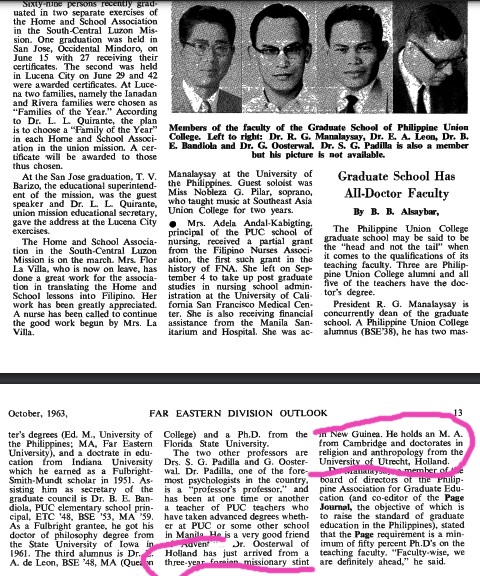
FAR EASTERN DIVISION OUTLOOK October, 1963, pp 12, 13

FAR EASTERN DIVISION OUTLOOK VOLUME FIFTY-ONE July, 1965 NUMBER SEVEN
p 21
REVIEW AND HERALD, July 18, 1968 Vol 145, No 29, p 19
REVIEW AND HERALD, August 17, 1967 Vol 144,
No 33
REVIEW AND HERALD, October 17, 1968 Vol 145, No 42
p 23
These Times
NOVEMBER 1 1968
VOLUME 77 No. 12
pp 4-7, 28


REVIEW AND HERALD, September 24, 1970 p18

REVIEW AND HERALD, December 2, 1971
pp 14, 15
FAR EASTERN DIVISION OUTLOOK November, 1974
p 6
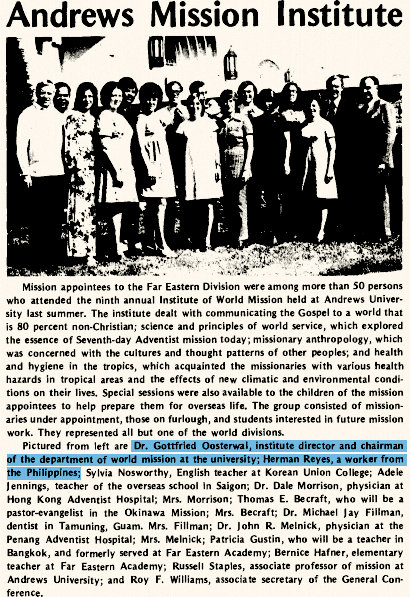
FAR EASTERN DIVISION OUTLOOK, September, 1967
REVIEW AND HERALD, November 23, 1967 Vol 144, No 47
FAR EASTERN DIVISION OUTLOOK, December, 1967
The position of the bachelor in the Upper Tor Territory American Anthropological Association (1959) by
People of the Tor;: A cultural-anthropological study on the tribes of the Tor territory (northern Netherlands New-Guinea) Van Gorcum (1961) by

Die Papua, Von der kultur eines Naturvolks W. Kohlhammer (1963) by

A cargo cult in the Mamberamo area (Ethnology) University of Pittsburgh Press] (1963) by
Island of forgotten men Review and Herald (1967) by

Die Insel der Vergessenen. Gottfried Oosterwal in Neu-Guinea, Erlebnisse und Erfahrungen. (German)SAATKORN-VERLAG Hamburg (1986) by

Worship Him who created the world, Unknown Binding – 1969 by
Mission: possible;: The challenge of mission today Southern Pub. Association (1972) by

"Fetch a robe and let's have a feast": (Luke 15:11-24) Unknown Binding – 1972 by
REVIEW AND HERALD, March 9, 1972
p 21

http://www.amazon.com/Modern-messianic-movements-theological-missionary/dp/B0006W3D8S/ref=sr_1_2?ie=UTF8&qid=1453990767&sr=8-2&keywords=gottfried+oosterwal
Modern messianic movements: As a theological and missionary challenge (Institute of Mennonite Studies. Missionary studies) Institute of Mennonite Studies (1973) by

p 20

R&H, JANUARY 10, 1974
pp 1, 3-5


R&H, JANUARY 17, 1974
pp 22, 23


pp 22, 23
R&H, JANUARY 24, 1974
pp 6-8
R&H, JANUARY 31, 1974
pp 6-8
R&H, FEBRUARY 7, 1974
pp 3, 9-11
R&H, FEBRUARY 14, 1974
pp 3, 6-8
R&H, MAY 9, 1974
pp 19, 20
R&H, SEPTEMBER 12, 1974
p 21
 |
| H. L. Reyes, 3d from L, 2d row; Mrs Reyes, 3d from L, 3d row |
FAR EASTERN DIVISION OUTLOOK January, 1975
pp 4-6
R&H, JANUARY 23, 1975
pp 20, 21
FAR EASTERN DIVISION OUTLOOK March, 1975
p 13

R&H, MARCH 13, 1975
p 21
R&H, DECEMBER 25, 1975
p 21

REVIEW, AUGUST 17, 1978
p 14
ADVENTIST REVIEW, SEPTEMBER 6, 1979
pp 16, 17
ADVENTIST REVIEW, JUNE 26, 1980
p 30
The Lord's Prayer Through Primitive Eyes: A Stone Age People's Journey by Oosterwal, Gottfried Pacific Pr Pub Assn(2009)
http://spectrummagazine.org/files/37.2_Spectrum_0409_web.pdf
How Then Shall We Pray?
14 Spectrum VOLUME 37 ISSUE 2 ■ SPRING 2009, pp 14-18
By Gottffried Oosterwal
This article is taken from The Lord’s Prayer Through Primitive Eyes (Nampa, Idaho: Pacific Press, 2009), and reprinted with permission. The apostle Paul told the believers in the ancient city of Rome that “we do not know how to pray as we ought” (Romans 8:26). But then he immediately assured them that we don’t need to worry about exactly what we should say or how to formulate our thoughts and praises and confessions and petitions because “the Spirit himself intercedes for us with sighs too deep for words. And he who searches the hearts of men knows what is the mind of the Spirit, because the Spirit intercedes for the saints according to the will of God” (Romans 8:26, 27). We hear something similar from Jesus Himself. When He walked the earth, it was customary for people to stand in public places at the three main hours of prayer and surrounded by many others, lift their arms into the air with the palms of their hands raised heavenward to show their piety and devotion. Onlookers may have been impressed by these people’s spirituality, but Jesus branded it hypocrisy. It’s not the words that count or the formulas or forms, but our attitude—our spirit and state of mind. “‘When you pray,’” He tells us, “ ‘you must not be like the hypocrites; for they love to stand and to pray in the synagogues and at the street corners, that they may be seen by men. Truly, I say to you, they have received their reward. But when you pray, go into your room and shut the door and pray to your Father who is in secret; and your Father who sees in secret will reward you’ ” (Matthew 6:5, 6). Jesus also counsels us not to “‘heap up empty phrases’” or use a stream of words (verses 7, 8). In His prayer then, He’s not intending to give us a formula or a standard prayer for every occasion nor a routine recitation of a holy text or a pious liturgy required for communal worship. He has designed His prayer as a model—given in outline form as the rabbis in His time all did—for every believer on how to enter into the presence of God as their Father in an attitude of trust and humble dependence upon Him. The Lord’s Prayer is an invitation from God for us to participate in His rule and reign of love here and now, as well as in the world to come. It represents a continuous dialogue between God and His people—a celebration of our salvation and our relationship with Him as our Father. This is not to say that right words and the form in which they are uttered are unimportant. Why else would Jesus have given us specific words and put those words in a specific form? Both are, like prayer itself, a gift from God, who has guarded this prayer till this day simply because He is anxious for us to be and remain part of His kingdom. He “desires all men to be saved and to come to the knowledge of the truth” (1 Timothy 2:4). The Lord’s Prayer is like a protective shield around us, a lifeline, a tie that binds us to God. He has given it to us as a comforter and a source of strength. It is a refuge and a promise that—like all other gifts and calls from God—are irrevocable (Romans 11:29)
The Disciples’ Request Luke tells us in his Gospel that one day Jesus “was praying in a certain place, and when he ceased, one of his disciples said to him, ‘Lord, teach us to pray, as John taught his disciples’” (Luke 11:1). Why the request? These disciples were believers— followers of Christ. They knew how to pray. They were Jewish men who from childhood on had learned to pray three times each day: at 9:00 a.m., noon, and 3:00 p.m. They prayed from memory the Shema, in which believers pledged to give their love and wholehearted devotion to the one and only God and to meditate upon His law, and in which they rehearsed the blessings for obeying and the curses for disobeying God’s commandments. They also prayed the Shemoneh ‘esreh, the “eighteen”—a liturgical prayer that originally consisted of eighteen short prayers appealing to God for His mercy and favor. Many of them also knew the Psalms by heart and prayed them together with prayers of thanksgiving before meals and for special occasions. They also prayed a host of ritual and communal prayers, one of the most important of which was the Kaddish, the proclamation of the sanctity of God. At the time of Jesus, this prayer was recited in response to the readings and explanation of a biblical text, the Haggadah. It started with the words: “Glorified and hallowed be His great name in the world which He created according to His will, and may His kingdom come in your lifetime and in your days...speedily and soon.” This prayer—though spoken mostly at memorial services and in a much longer form—is still highly honored in Judaism and deeply anchored in Israel’s soul. Yes, the disciples knew how to pray, and they did pray. Why, then, did they say they wanted to learn how to pray? We can deduce two main reasons for their request from the text itself. The first is the way Jesus Himself prayed. The text says that one day when Jesus was praying, one of His disciples requested, “‘Lord, teach us to pray’” (Luke 11:1). The disciples became aware of the enormous differences between their way of praying and the way Jesus prayed. We know that Jesus often was alone when He prayed—away from people but also from the worldly noises that surround us everywhere. Away also from the sacred places of prayer and from the rituals associated with them. For Jesus, prayer was spontaneous, not tied to any time, place, or ritual order. It was always new and fresh, not bound by tradition. Prayer was—and is—the most intimate way of relating to God. One stands before Him totally “naked” and alone. Jesus said that when we pray, we should go into our little “room” with the doors closed (Matthew 6:6)— meaning that we should separate ourselves from the environment that normally stimulates and shapes our thoughts and activities. We should remove ourselves from our daily worries and obligations, interests and desires. This doesn’t require a special place as much as it does a particular mind-set and attitude. For the disciples, as for many believers after them, praying was mostly routine, an honored duty, a ritual. It was mostly limited to certain times and places or special occasions. Their hearts and wills were not in it. After many years of repetitive practice, they hardly thought of what they were saying. Their prayers had become mere utterances of words, mechanical, something Jesus warned against in His sermon on the mount, in which He described it variously as “vain repetitions,” “‘empty phrases,’” and “ ‘meaningless words’” (Matthew 6:7, 8, KJV, RSV, TEV).
Beyond Routine Praying As all of us who have not given up praying altogether know, routine praying can easily deteriorate into a thoughtless, soulless, mechanical, and routine uttering of words. And then we are surprised when it remains so ineffective! That’s what perhaps impressed the disciples the most in Jesus’ praying—its effectiveness. He prayed, and He was able to multiply five loaves of bread and two fish into a meal that satisfied five thousand men, plus women and children. He prayed, and the sick were healed, the wind and the waves calmed down, and water changed into wine (Matthew 14; John 2). He prayed, and even the devil fled from Him (Matthew 4:1–11). He prayed, and He was enabled to accomplish God’s will for all of us, so that the whole world might be saved and come to the knowledge of the truth (Matthew 26:36–46; 1 Timothy 2:4). It is important to stress here that in all these events, Jesus acted as a human being, as one of us (Philippians 2:5–7). He had no powers that His followers may not also have through praying like He did! In teaching His disciples how to pray, Jesus offered them a way out of the often thoughtless, heartless, mechanical, and powerless forms of prayer. He offered them in thematic form a radically new approach that starts with God— His glory and His will—instead of being rooted in our needs and interests, thoughts and wishes. It’s a form of praying that, with a feeling of utter dependence on God and a deep sense of humility, asks for His will to be accomplished. Such an approach centers more on listening than on speaking and is oriented more toward God’s program and His intentions than toward ours. After all, our heavenly Father knows what we need before we ask Him (Matthew 6:8). Jesus Himself promises us that if we pray like this, He will grant us anything we pray for and empower us to do whatever He did on earth—and even greater things (John 14:12–14). The second reason why the disciples requested Jesus to teach them how to pray, according to Luke, is expressed in the words in the same way “‘as John [the Baptist] taught his disciples’” (Luke 11:1). In the days of Jesus’ ministry on earth, there were literally hundreds of teachers who, with their followers, wandered around the country proclaiming their particular message. Many of these teachers had a Messianic bent. Others were calling for a revival of the teachings of the prophets, while not a few were promoting movements of protest against the social conditions of the country or the occupation by the Romans. Jesus and John the Baptist were only two of them; other teachers represented the Essenes, the Pharisees, and the “Children of God.” To make clear what their particular message and mission were and to distinguish their teachings from those of the others, each of these gurus had designed a special prayer that embodied their mission and summarized their particular message. That’s why John the Baptist had prepared a special prayer for his disciples. Jesus’ disciples wanted a prayer that would summarize their message and mission and distinguish them from all the other groups, sects, and cults. And what a prayer they received! A summary of the gospel it is indeed. It also defines clearly Christ’s mission and therefore ours. But it is so much more: it is a shield against the powers of evil surrounding us everywhere; a power to live by; an instrument of God’s grace; and a source of happiness, peace, and righteousness. Martin Luther once described it as “an iron wall” that surrounds us everywhere and keeps us safe from the attacks of enemies and temptations—even doubt and unbelief. The Lord’s Prayer tells us that we are what we pray. What a wonderful thought to live by! To all who pray this prayer with Christ, it gives their true identity: it tells the world who and what we really are as individual persons and as a community of faith.
One Prayer—Three Versions In the Bible, the Lord’s Prayer comes to us in two versions: one is given by Luke (chapter 11:2–4), the other by Matthew (chapter 6:9–13). A third version developed later and has given the Lord’s Prayer the form we are most familiar with, one that is prayed around the world among Christians of all persuasions in more than two thousand languages and dialects, including that of the Bora-Bora, Berrik, and Nadjabaidja in the isolated interior of West New Guinea. Under the guidance of the Holy Spirit, Matthew placed the Lord’s Prayer right in the middle of Jesus’ sermon on the mount (Matthew 5–7). Literarily and symbolically, the Lord’s Prayer constitutes the very heart and center of Jesus’ inaugural address and therefore the very core of His message and mission. However, though the Lord’s Prayer is prayed around the world and has been for some two thousand years now, few have recognized that it is the very center of a radically new ethic, a whole new social order, a new form of relationship between individuals and nations—indeed, a new world order. And those who have drawn this conclusion have commonly considered this call for a new order and ethic more as an ideal to hope for than a reality to be implemented. However, from the beginning of His ministry, Jesus clearly announced that people who pray this prayer with Him should thereby also live up to the principles enunciated in His sermon on the mount: to be the salt of the earth and the light of the world; to act as peacemakers and champions for social justice; to love one’s enemies; to show compassion to the poor and feed the hungry; to always speak the truth; to be faithful to one’s marriage partner; and to refrain from judging anyone, which means that we should treat them the way we want them to treat us. There are no racists or sexists among those who pray the Lord’s Prayer with Jesus in the meaning and spirit in which He taught it! Many a government has forbidden believers to pray this prayer because of its revolutionary character and “subversive” nature, for this prayer does, indeed, have the power to change entire cultures and societies, and bring down governments and economic systems. And this prayer has inspired many a theologian to challenge traditional views of mission and notions of what it means to be the church in the world today. Though the versions of the Lord’s Prayer that Luke and Matthew gave have essentially the same structure and form, convey the same basic message, and share the same purpose and goal, the two do differ in a number of significant ways. These differences demand close study and attention because both these versions come to us as gifts from God Himself and because each of them emphasizes a particular message. Let’s look at the texts side by side. Obviously, Luke’s version is shorter, as is the term of address he uses, “Father,” while Matthew speaks of “our Father who art in heaven.” Luke totally omits the petition, “Thy will be done / On earth as it is in heaven,” as well as the petition, “but deliver us from evil.” Where Matthew uses the words this day, Luke writes each day, and where Matthew uses the term debts, Luke uses the term sins. And finally, the version according to Matthew reads, “As we also have forgiven our debtors,” while Luke has us pray, “for we ourselves forgive every one who is indebted to us.” There is no question about the fact that it is Jesus Himself who has given us this prayer. Neither should we doubt the fact that Matthew and Luke were both inspired by the Holy Spirit to hand the Lord’s Prayer down to us the way they have. The question then arises as to how these two versions developed in the context of the early church’s mission and ministry. Both versions developed in the decade of the eighties of the first century A.D., some fifty years after Christ was crucified, rose from the dead, and ascended into heaven. By that time, the message of the gospel had been spread all over the Mediterranean and had given rise to hundreds of house churches. Some of these developed among Jewish believers; others arose in the social, cultural, and religious context of the Greco-Roman world. As historical evidence shows, all of these newly developed churches attached immense value to the Lord’s Prayer as a confessional statement of belief, a means of teaching the gospel and building the believers in the faith, and as a source of comfort and strength in the often hostile environment in which they existed. It was an essential part of the Didache, or “The Lord’s Teaching Through the Twelve Apostles to the Nations”—the oldest Christian document other than the books of the New Testament, dating from the end of the first century A.D. In it, the believers are urged “after Jewish fashion” to pray the Lord’s Prayer three times a day. The Third Version The version given in the Didache is basically that of Matthew, but it adds a doxology that reads, “For thine is the kingdom and the power and the glory for ever” (Didache 8:2). Our present version came about as a result of Martin Luther’s Bible translation (1521–1522). Luther had found this doxology, which we all know now by heart, in a relatively late Greek manuscript of the Gospel of Matthew, and he considered it part of the original text. After his death, a number of Lutheran catechisms added these words to the Lord’s Prayer based on the Didache but also because they were believed to be part of the original manuscript of the Gospel according to Matthew. Today, this doxology has become an essential part of the Lord’s Prayer in all Christian churches, an ecumenical prayer of the truest kind. Bible scholars believe that the two versions given in the New Testament developed side by side in the different contexts in which the churches found themselves: the one by Matthew connected with the Jewish-Christian communities in what is now the country of Syria, and the one given by Luke among the believers of GreekRoman background. Some are of the opinion that both versions developed in their respective environments as part of these churches’ worship, liturgy, and mission and that Matthew and Luke then wrote their respective versions as they learned it from the believers for whom they labored. Others, however—and they constitute the majority at the moment—believe that Matthew and Luke, as shepherds of their respective flocks and apostles of the gospel, adapted the Lord’s Prayer to the particular religious and cultural circumstances under which they labored. Each version, then, is the result of a conscious and Spirit-guided attempt to relate the gospel to the needs and level of understanding of certain peoples in the context of their particular culture. Matthew relates the gospel to people steeped in Jewish liturgies, beliefs, and traditions. His version of the Lord’s Prayer shows remarkable similarities with the Kaddish— the announcements of the holiness of God. Identifying the Holy God, who is so wholly other from us humans, with “Father,” as Luke does, would be unthinkable and considered blasphemy of the worst kind. After all, the Bible tells us that for that very reason “the Jews sought all the more to kill him [Jesus], because he not only broke the Sabbath but also called God his own Father, making himself equal with God” (John 5:18). Matthew, therefore, needed to add to “Father” the well-known Jewish notion of heaven, a status totally different from our human condition and existence. For those he sought to win, the closeness of God to humankind expressed in the term “Father” needed to be complemented by the proper distance implied in the term “who art in heaven.” In their own way, however, both Matthew’s and Luke’s versions teach us how we should relate to God and to each other. For if God is the Father of us all, and we pray to Him as our Father, that makes all of us brothers and sisters, members of one family under God. That applies in both Matthew and Luke to believers and also to those who do not know Christ. God is indeed the Father of all humans by creation and redemption. So, praying “our Father” affirms with the apostle Paul that “‘he made from one every nation [and race and people]’” (Acts 17:26). It also means that we thereby pledge to live up to God’s ideal for His children, that we will consider people of all nations, races, religions, and cultures our brothers and sisters, that we will honor and respect them as such, and that we will share with them the wonderful message that God is our Father. Similarly, we learn from both versions in different ways what it means to be forgiven and to forgive others. We learn to regard “debts” as “sins.” We learn what it means to petition God for His will to be accomplished “on earth as it is in heaven” and to be “delivered from evil.” Matthew places the Lord’s Prayer in the contexts of Jewish liturgy, worship, and sensibilities. Luke, on the other hand, starts from the perspective of the separation of us humans from God as a result of sin and of how God in His grace has bridged that gap. The challenge given by the differing perspectives of these two biblical books is obvious: for mission to be effective, we must continually shape the gospel to the needs, interests, and sensibilities of those to whom we wish to communicate it. The gospel as summarized in the Lord’s Prayer must take on a totally different form when shared with Muslims than when shared with people of the Jewish faith or with those for whom prayer is meaningless or irrelevant. ■
For Further Reflection 1. How important are the forms and structures of our prayers compared to our attitudes and state of mind, our beliefs and relationships? How does the Bible describe those attitudes, beliefs, and relationships? 2. When Jesus prayed, things happened: the winds and the waves calmed down, water became wine, the paralyzed could walk, the deaf could hear, the mute could talk, and thousands of hungry people were fed. What would we have to learn from Jesus’ prayer life to make our prayers this effective? 3. From the beginning of Christianity, the Lord’s Prayer has played a prominent role in the church and in the lives of the believers—as a confession of faith and a statement of beliefs, a mandate and road map for mission, a mark of identity, a source of power, and as a unifying factor among the diverse groups of believers. What role, if any, has the Lord’s Prayer played in your communion of faith (denomination or congregation)— its theology and teachings, mission and ministry, worship and walk of life? How has it affected your personal life and pilgrimage? 4. What is the meaning and significance of the fact that in the Gospel according to Matthew, the Lord’s Prayer appears right in the middle of Jesus’ sermon on the mount, that revolutionary inaugural address in which Jesus expounded His message and His mission? 5. What is the role of the Holy Spirit when we pray? (See Romans 8.)
Gottfried Oosterwal is former professor of missions at the Seventh-day Adventist Theological Seminary, Andrews University, Berrien Springs, Michigan.
Patterns of SDA Church Growth in America Andrews Univ. Press (1976) by
Michael Belina Czechowski, 1818-1876: Results of the Historical Symposium about His Life and Work, Held in Warsaw, Poland, May 17-23, 1976, Commemorating the Hundredth Anniversary of His Death Znaki Czasu Publishing House (1979)by

Introduction / Foreword / Papers: 1. Konstanty J. Bulli, A Look at Europe in the 19th Century in the Light of Socio-Religious Aspects as Background of the Missionary Activities of Michael Belina Czechowski; 2. Zachariasz Lyko, The Polish Nation and Roman Catholicism in Czechowski's Time; 3. Rajmund L. Dabrowski, M.B. Czechowski: His Early Life Until 1851; 4. Rajmund L. Dabrowski, The Sojourn of M.B. Czechowski on the American Continent; 5. Alfred Vaucher, M.B. Czechowski: His Relationship with the General Conference of the Seventh-Day Adventists and the First Day Adventists; 6. Gottfried Oosterwall, M.B. Czechowski's Signifiance for the Growth and Development of the Seventh-Day Adventist mission; 7. Giuseppe De Meo, M.B. Czechowski - Pastor of Souls: A Study of His Life and Work in Italy; 8. Jacques Frei-Fyon, M.B. Czechowski in Switzerland; 9. Laszlo Erdelyi, M.B. Czechowski in Hungary; 10. Dumitru Popa, M.B. Czechowski in Romania; 11. Otto Uebersax, M.B. Czechowski: His Last Days and Death; 12. K.P. Mueller, Ellen G. White and M.B. Czechowski; 13. B.B. Beach, M.B. Czechowski: Trailblazer for the J.N. Andrews Central European Mission; 14. Jacques Frei-Fyon, A Survey of the Main Teachings of M.B. Czechowski; 15. Alfred Vaucher, Linguistic Talent and Publications of M.B. Czechowski; 16. Stanislaw Dabrowski, Religious Liberty and Juridical Status of the S.D.A. Church in Poland: The Flowering of M.B. Czechowski's Desires in Contemporary Poland / Colorful Incidents / Bibliography of Writings by or about M.B. Czechowski / Photographic Section
International business relations: Participant workbook Center for Intercultural Relations, Andrews University (1994) by


Spectrum Magazine
Our Sabbath with the Prime Minister of Papua New Guinea
Comment


FAR EASTERN DIVISION OUTLOOK June, 1965 Vol 51, No 6, p 5


No comments:
Post a Comment